Introduction
Long before the term “Actual Play” became popular as a term for streamed or recorded role-playing game sessions, gamers used to laboriously type up reports of their game sessions for others to read. Some of these were shared just between a GM and their players. Others reached a wider audience via APAs or fanzines.
Greg Stafford recorded several such reports from his house RuneQuest campaign, sharing some in The Wild Hunt APA at the end of the 1970s, and a few further extracts in Wyrm’s Footnotes at the beginning of the 1980s. 1
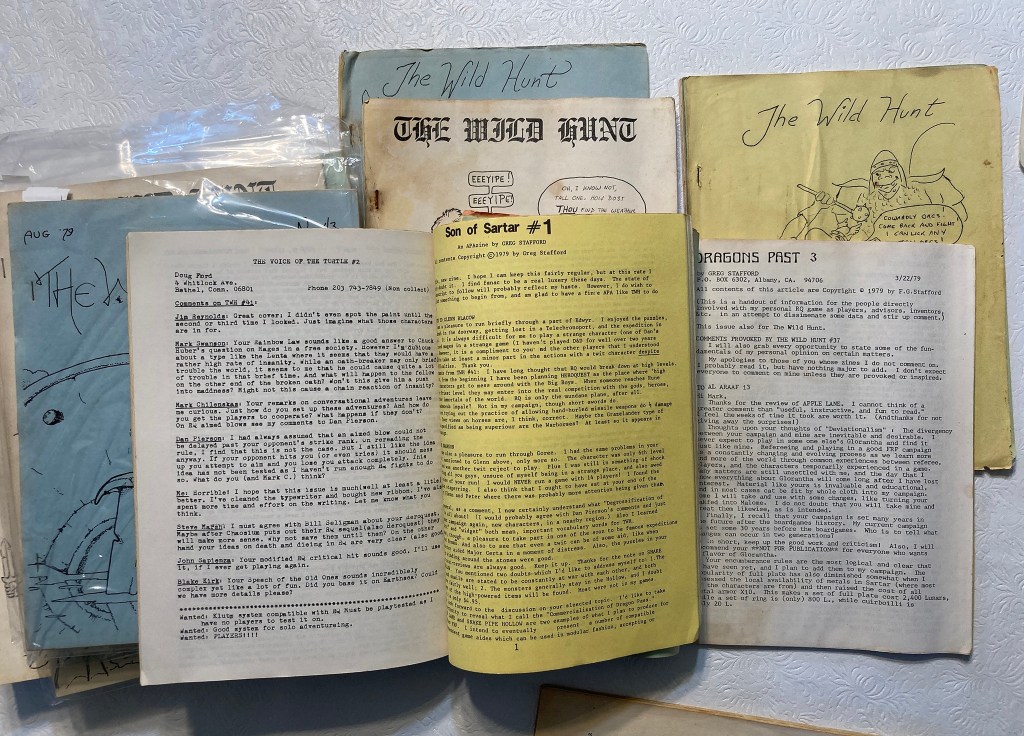
One such report, Dragons Past #8 (1980?) reported events from Greg’s campaign that took place during the game year 1615 2. The report on one expedition, “The Purchase of Anna”, is the one I’m going to look at in this post. For this session Greg’s group was joined by two guest players, one of whom then published their own account of the game in a major national magazine.
That account took on a life of its own.
The Purchase of Anna
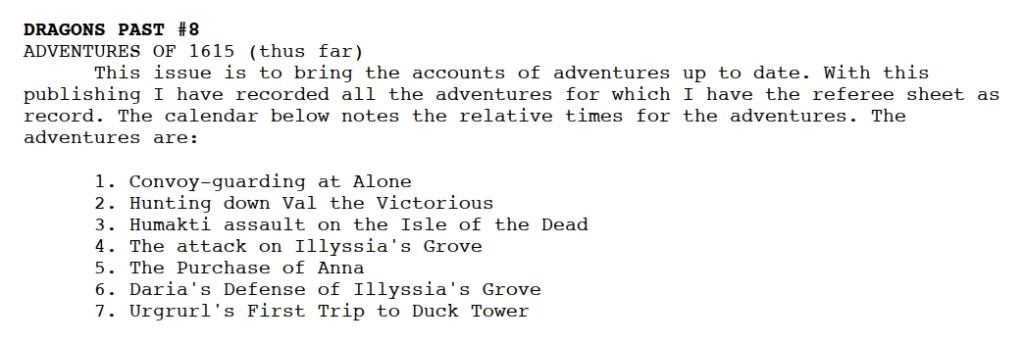
Seven game reports were included in Dragons Past #8. Across these seven sessions, no less than 42 player characters were name-checked as taking part, with one session alone having 15 characters involved. Although there were clearly a number of different players coming and going between different sessions, it’s not clear how many. In several sessions, players ran two characters each, and players also switched between characters from session to session. 3
Greg’s report presents the story of events shorn of any rules-speak. Seven players took part in the session titled “The Purchase of Anna”. The regulars played characters such as Humakti Rune Lord-Priest Errol Silksword; Asborn Demonslayer; Michael, a Colymar Thane; Dalzell, an Issaries merchant; and Urgrurl, the Iron Baboon, a Daka Fal Rune Lord 4. The two other characters, Mora, a Lawspeaker, and Wyvark, a warrior, were played by guests. Greg doesn’t make any distinctions in his own session report, he just lists all the characters. We know who the guests were from later context.
The adventure centred upon a quest into Lunar lands, to buy back (or re-capture if necessary) a Sartarite farmer, Anna, a member of Alebard’s household. She had been sold into slavery when the Lunars captured the city of Jonstown. The player characters were sent by their clan and tribal leaders, and equipped with a wagon and trade goods.
In the first part of the adventure, Greg reports that the journey was completed “without incident”, other than some petty in-party squabbling. Once at the destination, there was a prolonged negotiation to purchase Anna out of slavery, with significant input from the Lawspeaker. The party then travelled onwards and traded in Furthest. On their way home, the party camped out overnight. Their rest was interrupted by a dramatic and deadly encounter:
“They were approached by a blue-skinned stranger who demanded money and a
horse as toll. The party refused and were abruptly attacked by the man after he
transformed into a raging sky bull. Lord Michael was incapacitated by the beast as others were engaged in combat by Shades and other bad magic things. Mora Lawspeaker was killed by one of the shades, but after many struggles they managed to drive this stranger off. Everyone was wounded in the fight”.
“After returning home the party learned this person was called Eluce, and was a shape changer of some ancient cult otherwise unknown. They felt themselves lucky to escape, and related their tales over a feast of celebration for the return of Anna”. 5
In a later game session 6, many of the same player characters were assembled in a party again, and sent by their clans to resolve incidents of herds being raided. They encountered Eluce again, discovering him to be a powerful and unusual shaman. They fought him and drove him off with the help of a stranger who controlled a Tyrannosaurus rex.
These episodes seem fairly typical of Greg’s RuneQuest games of the time, judging by the other “Dragons Past” accounts. Much of the game was well-grounded in the setting and revolved around social interaction. But the reports are peppered with bouts of violence and magic, in the traditional FRP style.
Like playing piano with Mozart
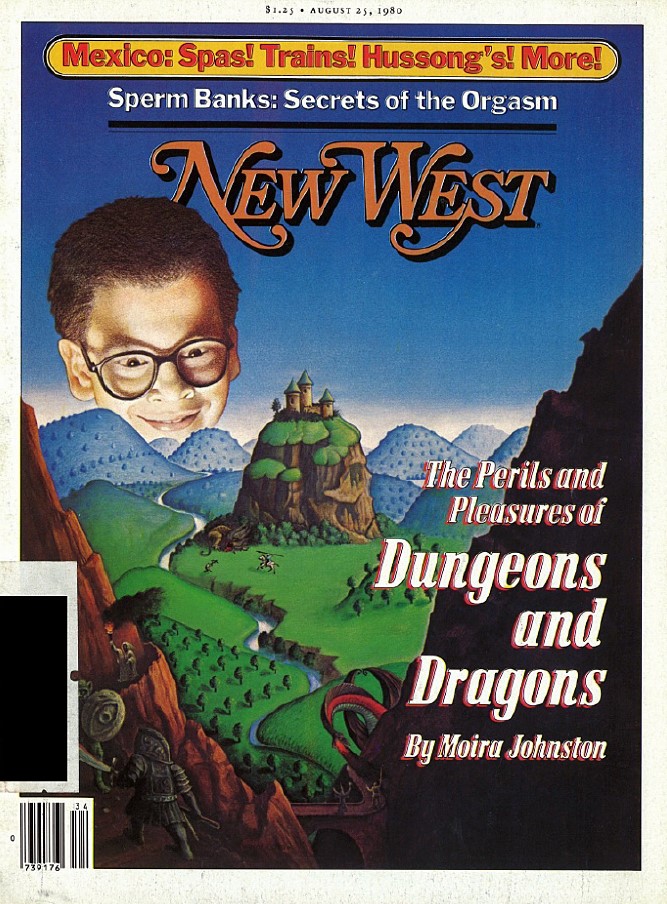
In August 1980, an article titled “It’s Only a Game – Or Is It?” appeared in the magazine New West 7. In some detail, it addressed the rising controversy over the supposedly problematic content of fantasy RPGs. The author was Moira Johnston.
The article jumps straight into its topic by reporting a five-hour Saturday night game of RuneQuest, “around a kitchen table in a modest bungalow in Berkeley”:
“My thirteen-year-old son is silent with awe. He is watching Greg Stafford, one of RuneQuest‘s creators. Greg will lead the game. It is like being invited to play piano with Mozart”. 8
Johnston’s interest in the role-playing phenomenon had been sparked a year or two earlier. Her son, Don, had been introduced to Basic Dungeons & Dragons at school, rapidly moving on to Advanced Dungeons & Dragons, and then other games. Creating his own dungeon maps, Don had borrowed ideas from history: the labyrinth at Knossos, medieval castles, and the layout of ancient Babylon. Aged thirteen, he had submitted his first article to Dragon magazine.
Johnston worried about how quickly and deeply these RPGs had seduced her son, and how that might affect his life. And even while sitting down for her Saturday night game session with Greg, she was well aware of darker fears spreading in the wider culture:
“Here, the dark side doesn’t show. But it is there, stalking the new games like a specter, casting a shadow of sinister implications over our apparently harmless fun. Implications of sadism and the occult. Of the satanic. Of schizophrenic withdrawal from reality. The games are creating controversies as potentially volatile as the teaching of Darwinian theories in the thirties. They are breeding fear. And fierce hostility”.
Despite this injection of external drama, Johnston’s account of the game of RuneQuest seems clear and fair. She and her son play brand-new characters, freshly created by the GM, Greg Stafford. Wyvark, played by Don, is a foolish, idealistic young warrior. Mora, played by Johnston, is a knowledgable but clumsy Lawspeaker. Yes, this is the exact same session reported by Greg in Dragon’s Past #8 as “The Purchase of Anna”.
“To reach Ms Errol Flynn’s sister, we must move through Snakepipe Hollow, ‘one of the worst stinkpots of chaos in the whole of Dragon Pass’, Greg tells us. ‘A barbarian land beset by wolves, broos, walktapi and bandits. And two mile-long dream dragons that can think whole armies to death’. What use Lawspeaker’s knowledge of law in this hellhole, I wonder?” 9
Johnston clearly paid close attention both to the way a role-playing game worked, as well as to many of the details of the setting and story that Greg shared. She observed that Glorantha was “set somewhere in a pre-medieval age of anarchy, magic and epic saga”. For this session, Greg used miniatures (“exquisitely hand-painted, they look like figures from Tolkien or Arthurian legend”) and a map laid out on the table, but it’s clear nonetheless that “the adventures will happen in our heads”.
In Greg’s report, the party’s journey north was completed “without incident”. However, Johnston recalls this first part of the session very differently.
The party is on the watch for wolves, who stalk the group, but Greg’s dice determine that the wolves don’t attack. Instead, the party is attacked by a mysterious woman in a white gown, not a vampire, but some kind of “chaotic illusion”. The battle is short and bloody: the attacker has one arm severed, gets slashed in the abdomen, and then speared in the head by Wyvark. Hit locations for the win!
Johnston has a further detail regarding this foe:
“Greg knows that she is a succubus, that luscious demon of mythology who descends on me when they are asleep in lonely outposts and lures them to sexual intercourse. Greg will bring her back on some other run, perhaps in her male form as an incubus who impregnates women as they sleep”.
This encounter isn’t mentioned at all in Greg’s report, but it would go on to become a lasting legacy of Johnston’s article. According to Joseph Laycock 10, campaigners against roleplaying quoted this article on repeated occasions over the next twenty years. The presence of a succubus, a sex demon, was surely prima facie evidence for the case against RPGs. Especially with a 13-year old playing in the session – exactly the opportunity for corruption that campaigners feared!
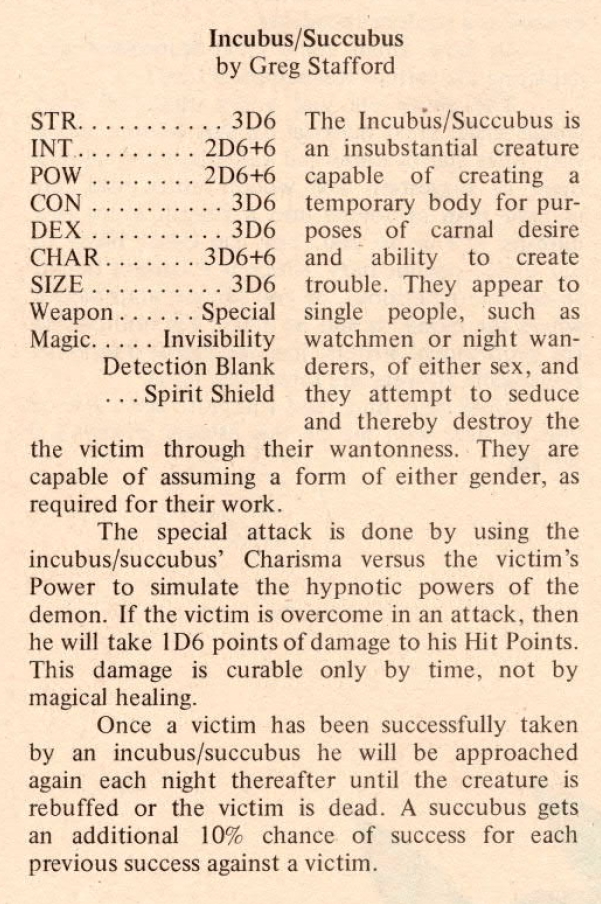
Greg had published RuneQuest stats for the incubus / succubus in Dungeoneer magazine just the previous year. It doesn’t sound like the sort of foe that would be so foolhardy as to attack a well-armed group on its own: 11
During a break in the game, Johnston recovers from “the exhilaration of action”.
“For three hours, my emotions and imagination have been thoroughly
engaged by a game. For the first time, I have felt the power of a phenomenon so dynamic that it is creating a new American subculture”.
The second encounter, with the “sky bull” and shades, described in Greg’s own account, is also reported with vivid detail by Johnston. For this encounter, her report is consistent with Greg’s own. Lawspeaker fumbles, impaling himself on his own spear, then has his right arm ripped off by a wolf.
“All is chaos. Like a military commander, Greg gives structure to the chaos by calling out, at the end of every round of violence, ‘Strike rank,‘ and tells us, by dice rolls, how much damage our characters have sustained”.
Mora Lawspeaker is then slain by a shade – and a desperate roll for divine intervention fails.
The rest of Johnston’s article is an extensive and interesting account of the role-playing scene of the day, interviewing Lee Gold, Gary Gygax, Dave Hargrave and others. Indeed, the article seems to spend as much time letting these participants rehearse their mutual feuds as it does tackling the supposed dangers of FRP.
Johnston’s description of the games as an interactive artform stands out:
“FRP can perhap best be understood as Tolkien in 3-D. As living theater. Psychodrama. As a coming together of two forces of the seventies—fantasy books and encounter groups. As the thinking man’s cops and robbers, FRP is magic, violence and power. And it is played out mostly in the mind”.
At one point in the article, a group of RPG luminaries assembles in a house in Berkeley, California to discuss the hobby with Johnston.
“Greg Stafford, cult figure of growing stature as owner of Chaosium. Inc., the company that publishes RuneQuest, exclaimed: ‘This is the Left Bank of FRP, right here in this room!’”
They defend the power of RPGs as a sanctuary for the shy, sensitive and cerebral.
“‘Yes, yes,’ Greg Stafford had leaped in, ‘I had lots of acquaintances as a child
but few close friends.’ ‘For the shy people being abused,’ Steve Perrin, the
writer of RuneQuest‘s rules, had added, ‘the element of being important is very significant. After you’ve slain four dragons, who cares about the school bully?’”
Challenging the criticism of RPGs as somehow satanic and amoral, Greg notes that FRP is closely connected to the broader topic of mythology, observing:
“‘Merlin’s father was an incubus,’ and adding, ‘Yes, there is opportunity to be despicable, but there is much more opportunity to be virtuous. RuneQuest rewards trust, honesty, and cooperation’”.
Johnston never comes to a firm conclusion, but she certainly gives the gamers a fair hearing. And although she doesn’t reveal it in the article, it’s perfectly clear that her experience at Greg’s table gave her no great cause for concern. Her son, Don, was allowed to return to play Wyvark at least once more, for the subsequent encounter with Eluce. 12
Epilogue
In August 1980, the campaign against RPGs was still in its infancy. The month-long disappearance of James Dallas Egbert III, a D&D fan, had taken place about a year before Johston’s article appeared. Egbert’s tragic death by suicide on August 11th 1980 occurred two weeks before the publication of this issue of New West, too late to be acknowledged in the article. The tragic death of Irving Lee Pulling still lay two years in the future.
The association of gaming with the Satanic Panic would grow steadily throughout the 1980s. Greg Stafford himself was eventually compelled to co-write a pamphlet for the Game Manufacturers’ Association (GAMA) in 1988, Games Don’t Kill: A Look at the Claims. 13
Throughout that period, Johnston’s article had a lasting legacy in fuelling the fears of the anti-RPG campaigners. Seen from greater distance, I think it remains a useful historical document of the RPG scene of its time. And it’s interesting to see how Greg’s own RuneQuest game, chosen as the exemplar for all FRP, was described in detail by an outsider.
I don’t know why Johnston reported an incident in the game that Greg omitted from his own account. I guess that Greg simply forgot about it or thought it was inconsequential.
I wonder whether Greg read Johnston’s article. Getting described as the Mozart of FRP was pretty cool, and overall I think the article showed him in a very positive light. It’s a rare chance to see how a mostly-sympathetic outsider understood FRP. It’s also a reminder of how easily minor elements of the experience can be picked up, misunderstood or misinterpreted by anyone with an oppositional agenda.
- See https://wellofdaliath.chaosium.com/home/catalogue/publishers/greg-stafford/greg-stafford-personal-works/dragons-past-1979-1980/ for a list of many of these. ↩︎
- This is reprinted in The Stafford House Campaign, Greg Stafford, Chaosium, 2022. ↩︎
- For example, Charlie Krank played Errol Silksword, Alebard and Alexander Yellowbelly; while Sherman Kahn played both Urgrurl and Naimless. ↩︎
- From BRP Central, we know that Charlie Krank played Errol Silksword; Hal Moe played Asborn; and Sherman Kahn played Urgrurl. ↩︎
- The Stafford House Campaign, p44. ↩︎
- “Dragons Past #10″, The Stafford House Campaign, p52. ↩︎
- For a useful summary of the article, see https://grognardia.blogspot.com/2021/04/the-perils-and-pleasures-of-dungeons.html. ↩︎
- “It’s Only a Game – Or Is It?”, Moira Johnston, New West, 25 August 1980. All other quotes by Johnston are from the same article. As of October 2026, that link is temporarily not working, but the article can also be found here. ↩︎
- The character Errol Silksword changed name over time, also going by the name Errol Flynn. ↩︎
- Dangerous Games – What the Moral Panic over Role-Playing Games Says about Play, Religion and Imagined Worlds, Joseph P. Laycock, University of California Press, 2015. ↩︎
- “Monster Matrix”, Greg Stafford, Dungeoneer #14, p58, 1979. ↩︎
- “Dragons Past #10″, The Stafford House Campaign, p52; the referee’s character summary sheet is also provided, p83. ↩︎
- If anyone has a copy, I’d be interested to see it. ↩︎


Leave a Reply