Autumn / Fall 2026 is the 60th anniversary of the discovery of Glorantha. I think that is worth celebrating.
And that means celebrating Snodal.
I have been to the very edge of the world, far beyond the most northern lands of men, beyond even the endless lands of the eternal winter.
I was driven from the battlefield where I had fought alongside my valiant brother, forced northwards to escape the victorious barbarians.
In the winter lands I was taken captive by the ice god and his snow demons, and escaped only when freed by ancient demigods there, the Altinae. They live beyond the ice, and they know of gods whose names have long passed from our own memory.
Their land is a paradise of valleys, and orchards, and streams, and impossible towers, and yet it is a prison for them. They are punished for their failure to defend the world in the Long Night, when it faced its greatest peril.
Their library holds manuscripts beyond our scholars’ most hopeful dreams, endless shelves and stacks of knowledge of pasts and futures, and worlds beyond our imagination.
There I saw an atlas of the future, mapped by the wizard Zzabur. It showed our homeland destroyed, a great cataclysm that the wizard himself had planned. I learned that no ordinary man or woman could defeat the enemies who still threated our homeland. But the return of my son, born to my Altinae Damosel, brings me true hope.
I will not wait to see how he fares. I will do what I can myself. With my friends Svenlos and Arthen, and my gifts from the Altinae, we have already settled affairs with my old foe, Black Hralf. Now I have spoken to the priests and the sorcerers, and we have our own quest. We will cut our enemies off from each other, destroy their unity, and prevent Zzabur’s plans from ever coming to pass.
I have seen paradise, and I wish my son to build such a world here, for all of us. I have faith that he might fulfil the promise that Hrestol himself first gave us those many ages ago.
Borne into Glorantha
“I wrote this one night in 1966 in a moment of creativity, and it bore me into Glorantha” – Greg Stafford 1.
It is now sixty years since Glorantha was first discovered, in the Fall of ’66. Eighteen-year old Greg Stafford had just started his studies at Beloit College, Wisconsin. He had recently returned from a hippy summer in Los Angeles, and he now wished to acquire the tools to become a writer 2. Perhaps he was also keen to do well enough at his studies to retain the 2-S selective service classification, an exemption from the draft for students who maintained good enough grades. Some of Greg’s friends had gone to ‘Nam, and he feared following them “more than anything else” 3.
Greg was already an avid reader of books about sagas, myths and legends. By the time he arrived at college, he was already quickly exhausting the material he wanted to read 4:
“I was a young man full of energy and I was passionate about mythology. I had read everything I could find in mythology and was frustrated that I couldn’t find more.” 5
“I remember quite clearly sitting down at my desk to write a vignette. I still have that first page, in fact. It’s framed. That led to an explanation, which led to a story, which led to the blossoming of Glorantha.” 6
This first page had no obvious context. Initially, it was just a tiny fragment of a story, seemingly without any broader background or setting. Greg reported that he later “discovered” that the text portrayed people escaping from the destruction of the land of Seshnela at the end of Glorantha’s Second Age.
The fragment is a diary written by one of those survivors, fleeing from their “beloved homeland” with companions in a boat. Only seven of the group survive storms, waves, starvation, and an attack from a giant aquatic worm. They make landfall in the land that we now know as Fronela, some way to the north of Seshnela.
The birth of Snodal
Greg swiftly turned his attention to creating a much more detailed tale.
“It was Snodal. I remember it well. Snodal first.
“He found himself, one frozen evening, before a great guardian spirit which kept him from his past. He had no memory of that past, not of himself, or his nation.
“He had fought that great, mottled creature. Spirit. Draugr more like, twelve feet tall. It bore a double-bladed, two-handed axe, and wore only a loin cloth in the stinging snowstorm. It spat and drooled.
“But Snodal killed it, and so he got to Altinela. He bore with himself only one thing: a ragged fragment of his ancestor’s diary. This he matched to their records, and to find himself again Snodal began recording the history of his homeland”. 7
Once he had a character and some context, Greg’s drive quickly became to know more and more about his story and its setting.
“I wrote a little background about [Snodal], and then background about the background, and Glorantha started to gush out of my fingers towards the typewriter”. 8
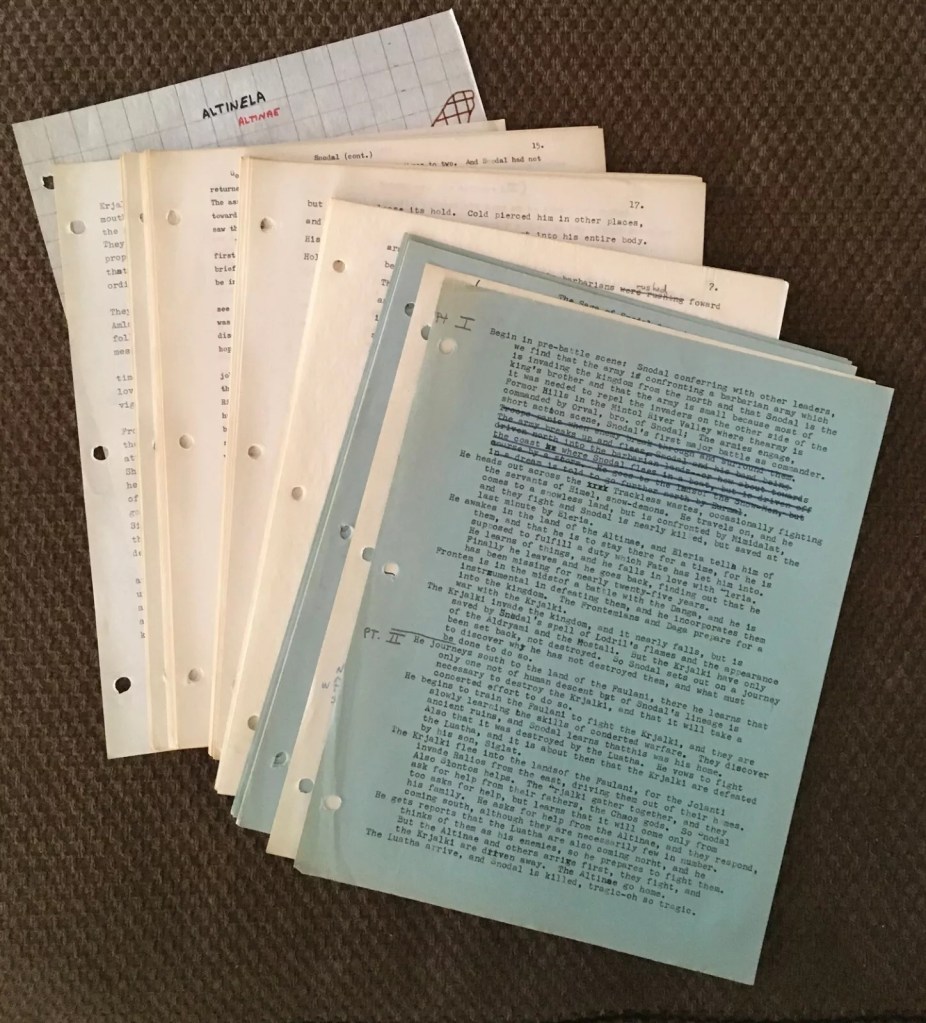
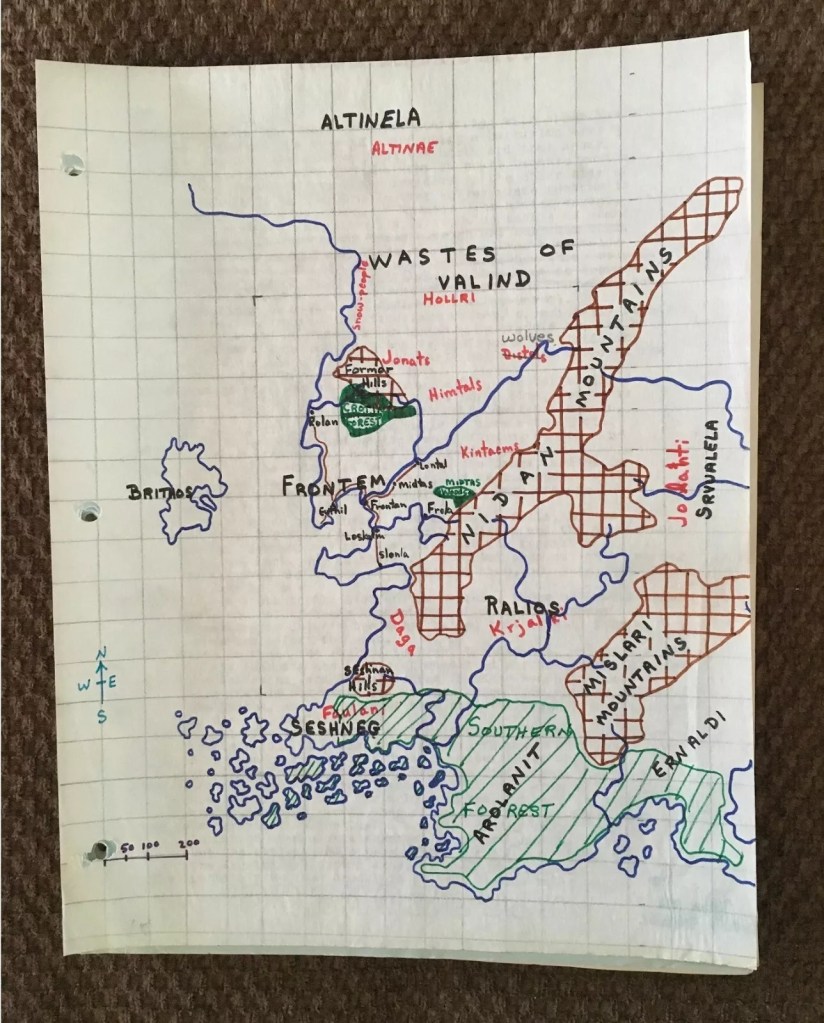
Greg moved onto creating notes about Snodal’s homeland, Loskalm (called Frontem in these early tales). Very soon, the creative urge took Greg back to Seshnela, which would become the focus of his writing from roughly 1966-1969, during which time he finished at Beloit College, moving on to Southern Illinois University and then DePaul University.
Large volumes of Greg’s writings about First Age Seshnela were later collected in the Roots of Glorantha series, limited edition volumes first circulated in 2007. The contents were later reprinted as a reward for top-end Guide to Glorantha Kickstarter backers in 2015 9.
Those writings introduced people and peoples well known to fans from more widely available Gloranthan material, such as the Brithini, Vadeli, Argat (later Arkat), and Gbaji, amongst others. However, Snodal features only fleetingly in the Roots volumes.
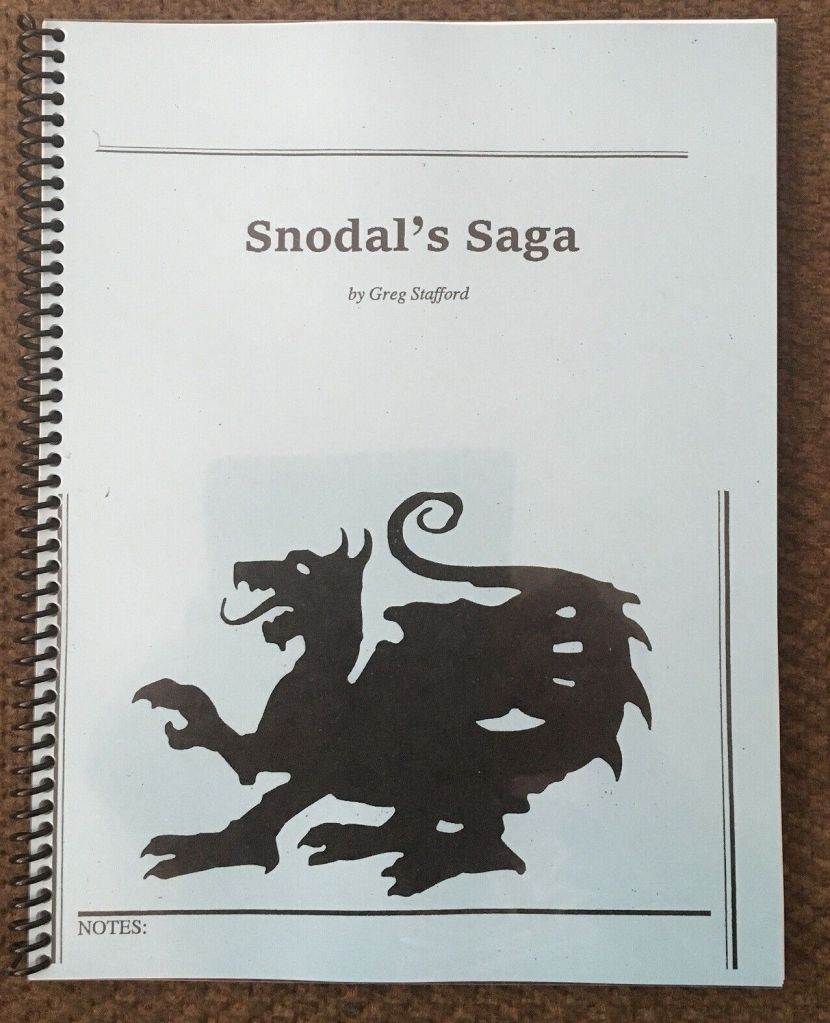
Much later, Greg compiled his early writings about Snodal and made them available to a very limited number of buyers in bound form as Snodal’s Saga. This is sufficiently rare that it doesn’t get a picture or even a mention on the Well of Daliath website or in the Meints Index to Glorantha. I’m not sure exactly when it was compiled and circulated.
I understand that some of the same Snodal texts were also shared as “Deep Sources” with the top-level backers (“Heroes”) of the Glorantha Trading Association. The GTA was the membership structure founded in January 1999 to help fund the work of Issaries Inc.
A few photographs of some of the pages were shared when a copy of Snodal’s Saga was auctioned on eBay a couple of years ago. I’ve relied on those to help uncover a little about the early, not widely circulated Snodal material.
The opening text for this article is simply my own creative interpretation of the Snodal story.
In the original Snodal tale 10, the warriors of Frontem are confronted by barbarian “Jonati”. The Frontemians panic and are defeated when they mistake one of their own wizard’s explosive spells for enemy magic. Prince Snodal flees north with a barbarian, Ratskek, until the duo are eventually ambushed by hollri snow demons. Ratskek escapes, but Snodal is captured.
Snodal awakens, and is brought to Himel, the god of ice and cold, son of Nakala. Snodal is rescued when another god, Urtiam the law keeper, a representative of “The Nine”, intervenes.
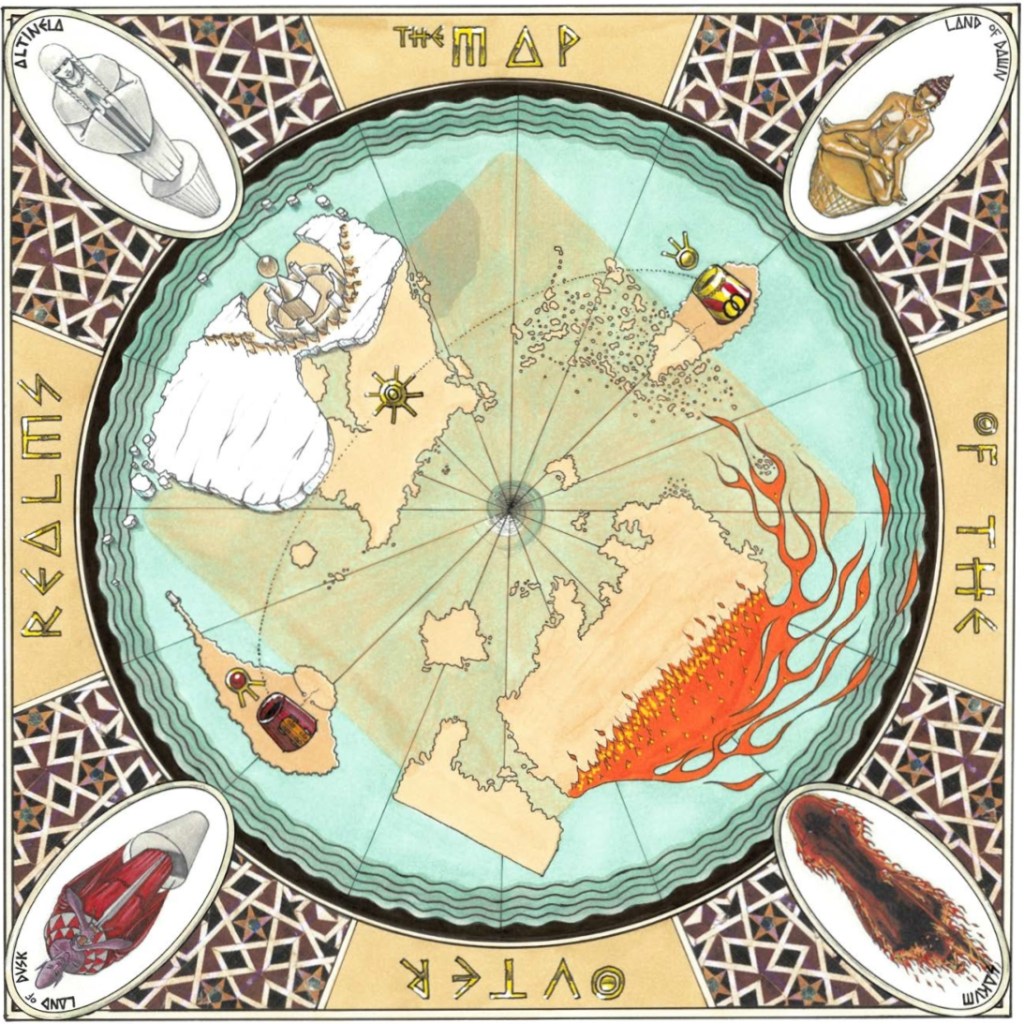
Snodal awakens again, now rescued by a group of Altinae, including their Princess Eleria. The Altinae are descendants of the nine Great Gods of Acos 11. They take him to Altinela, where Eleria explains how the Altinae had feuded with another race of demigods, the Luatha, neglecting their duty to defend the world against Chaos. Ever since, they had been condemned by the Gods to forever defend the northern edge of the world from Chaos 12.
Many of the entities mentioned by Eleria in her conversation with Snodal survived into later Glorantha, albeit in many cases heavily revised: Humakt (here more of a prototype Umath than a death god), Zrethus (also spelled Zrenthus, a.k.a. Aether), Gata, Lodril, Ehilm, Urtiam (sometimes spelled Utriam), Hykim, Flamal, etc.
Snodal returns home from Altinela to find that his homeland, Frontem, is at war with the people of Danga. Snodal discovers that the Danga are themselves fleeing krjalki Chaos Demons, and he convinces both nations to unite against this common foe. With the power of the Frontemian wizards summoning the fire of Lodril, and aided by Aldryami and Mostali allies, the krjalki demons are defeated.
Snodal’s reunion with Ratskek appears briefly in one other tale that has been shared from the archives, the “Tale of Thanmor-Ratesk” 13. In this short tale Thanmor (a.k.a Ratskek) is reunited with Snodal after the Prince had returned to Frontem / Loskalm, helping him to defeat the krjalki 14 15.
With the battle won, Snodal’s friend Svenlos visits an oracle and learns that the krjalki can only be permanently defeated by “one from another world”. This will presumably be Snodal’s son, Siglat, born in Altinela to both human and Altinae parents.
I guess this may all feel pretty arcane to many Glorantha fans, so I’ll try to summarise a few key points.
Snodal was the first Gloranthan hero to be described, active in a region of the world (north-western Genertela) that was pushed to the edge by later development. He leaves the mundane world and encounters gods and demigods, but without the intentionality of later heroes (notably Harmast and Arkat) – it’s a journey, not a quest. The entities he meets, the places he sees, and the timeline of events, read today like a scrambled version of our more familiar Glorantha. Although some elements of the tale are later discarded, and others heavily revised, I’m impressed quite how much of this first tale of Glorantha survived to define aspects of the more developed setting.
Inspiration for the Snodal saga
Greg claimed on several occasions that before he discovered Glorantha, he had never read any fantasy or science fiction.
“I had, however, read just about every European literature of the medieval and Greek eras.
“Iliad, Odyssey, Beowulf. Le Morte d’Arthur, Charlemagne, Mabinogion, Irish myths, Icelandic sagas, Geoffrey of Monmouth, Snorri Sturlasson, Saxo Grammaticus. That’s a good start”. 16
Elsewhere, he reports reading many of these classics first in grammar school, then in High School, before graduating to fantasy fiction only afterwards:
“In college I met Elric, then Bilbo and Frodo, then Conan, in that order. Those were the years when Lin Carter was editing the Adult Fantasy Series for Ballantine. I was lucky enough to get exposed to the old masters like Dunsany, Lovecraft, Smith, and then the rest of Moorcock’s tales”. 17
I don’t know whether the tale of Snodal was initially described as a “saga” or whether that term was added later, setting it alongside Greg’s later Jonat’s Saga, Arkat’s Saga and Harmast’s Saga. The Snodal tale does have some faint echoes of the Nordic sagas, several of which feature travels into the frozen north, including the land of the ice giants, Jotunheim. These resemblances seem partial at best, and I don’t think there is any direct parallel for the events, mythology or characters of Snodal’s Saga.
The land of Altinela resembles the Hyperborea of Greek myth: a beautiful and perpetually sunlit land found beyond the icy wastes of the north, populated by blessed people who lived for 1000 years.
Greg stated that he read the Elric stories at some point in 1966 18, so depending on the timing, I wonder whether this may have been the possible source of the Snodal Saga’s very early reference to “Chaos” within proto-Glorantha 19.
Snodal today
Setting aside the early material, what do we know about Snodal from more readily accessible material, now evolved into current Gloranthan canon? The current version of his story is similar, but not exactly the same.
Snodal doesn’t get an entry in Cults of RuneQuest: The Prosopaedia, relegated there to his role as father of Siglat, who became the founder of modern Loskalm and the utopian creed of New Hrestolism 20. Siglat’s mother was “an immortal called the Damosel of the Black Veil”, making Siglat a demigod (a semidemigod?): the child of a human and one of the Altinae.
Most of what is now readily available about Snodal can be found in The Guide to Glorantha. This clearly draws on the original version, but it has evolved to make sense when set alongside later understanding of the world.
According to The Guide, Snodal was a prince amongst the Loskalmi, who took part in a battle against the White Bear Empire in 1443, alongside his brother, King Orval. The Loskalmi were defeated by the barbarians, led by Black Hralf the Weasel, and Snodal fled north, ultimately to Altinela. While there, Snodal saw a map of Fronela, one generation into the future, with most of the land destroyed, and he vowed not to let this happen.
Five years passed for Snodal while in the magical land of Altinela, but forty years passed in Fronela before he returned in 1483. Now aided by his friends and heroes Arthen and Svenlos, and magics gained from the Altinae, Snodal led his followers to victory against Black Hralf.
The “mysterious Damosel of the Black Veil”, one of the Altinae, arrived from Altinela with Snodal’s son, Siglat. The age of Siglat is unclear, but he would very soon become King of Loskalm.
Snodal discovered from a foreign priest that the map of the future held by the Altinae had been drawn up by the wizard Zzabur. It depicted the end-result of the wizard’s plans: to sink Fronela (the motivation is also unclear).
In 1499, Snodal led a heroquest with priests and sorcerers, killing the God of Silver Feet, a local trade and communications god.
Snodal is said to have then disappeared and never been seen again, although a mausoleum was built in his memory in the city of Ease. His heirs are reported to have summoned back his ghost, which explained that the heroquest had been necessary to thwart Zzabur’s plan (quite how this works is, yet again, unclear).
Meanwhile, the Syndics Ban descended upon all of Fronela, preventing communication across most of the land for many decades, over a century in some lands. This period of isolation allowed Snodal’s son Siglat’s new utopian Loskalm to develop safe from harm, at least until the Syndics Ban came to an end, revealing new enemies who had grown in secret …
Celebrating Snodal
I think we must be grateful to Prince Snodal for providing the spark in 1966 that grew and grew, drawing Greg Stafford deeper and deeper into Glorantha. The 60th anniversary is a great opportunity to pause, take stock, and celebrate.
I think it is regrettable that much of Snodal’s tale remains obscure, essentially available only to the fortunate few. His story feels like one that would still be worth reading (and this is really not true of all Greg’s early Gloranthan writing!)
(Hopefully that can be remedied one day.)
Even with the bare outline of his story set out in The Guide to Glorantha, I think Snodal is one of Glorantha’s more interesting characters. Which other mortals, if any, have travelled to a place like Altinela at the very edge of the world, and then returned? 21 Who else has heroquested to slay a god, and so prevent certain doom for his entire native land?
Although the early texts are inconsistent with our more modern understanding of the setting, they reveal or hint at possible further adventures. Snow demons! Chaos demons! An encounter with a god! Exploring a palace of ancient demigods! And plenty more.
Of Greg Stafford’s earliest writings, I definitely find these to be some of the more interesting, closest to a classic swords-and-sorcery tale of weird adventure.
Thank you Snodal!
And thank you, as always, Greg.
- How I Discovered Glorantha, The Stafford Codex website, undated. ↩︎
- Gloranthan Genesis, Questlines, 1996. ↩︎
- Gloranthan Genesis, Questlines, 1996. ↩︎
- Designer’s Notes, Glorantha: Genertela, Crucible of the Hero Wars, 1988. ↩︎
- Interview with Franck Florentin, Christophe Seoane and Jérôme Bouscaut, in Jeu de Rôle Magazine #10, April / May 2010, translated with assistance from Stéphane Landelle. ↩︎
- Q&A at The Acaeum, 2006. ↩︎
- Gloranthan Genesis, Questlines, 1996. ↩︎
- Interview with Serge Olivier in Casus Belli volume 2, #1, March 2000, translated with assistance from Stéphane Landelle. ↩︎
- https://wellofdaliath.chaosium.com/home/catalogue/publishers/moon-design/moon-design-kickstarters/guide-to-glorantha-kickstarter/roots-of-glorantha/. ↩︎
- What follows summarises a fragmentary version of the text, and is not complete. ↩︎
- From the names of the gods cited, I think these are essentially the same as the Nine Great Gods of the Enerali, as per The Guide to Glorantha, page 373. See https://wellofdaliath.chaosium.com/barbarian-old-gods/ and https://wellofdaliath.chaosium.com/notes-on-the-old-gods/, for the scholars (and who is reading this, if not scholars?) ↩︎
- See also Cults of RuneQuest: The Prosopaedia, page 5, and The Guide to the Glorantha, pages 158-159. ↩︎
- See https://wellofdaliath.chaosium.com/story-of-thanmor-ratesk/. In The Guide to Glorantha, Thanmor is listed as the son of Jonat, and so the second king of the Jonatings, who lived around 400 years before the time of Snodal. However, in this story Thanmor witnesses the battle between the “Frontemi” (an earlier term for the Loskalmi) and accompanies Snodal fleeing northwards. Perhaps this is an example of the shifting chronology of these early tales, or perhaps instead it’s just a different Thanmor entirely. Regarding the chronology, consider the “Daga” of the Thanmor-Ratesk tale, named the Daga / Danga in the original Snodal texts. They may or may not be related to the Dangans of around a thousand years earlier who we can find in the canonical Gloranthan chronology. They are a tribe or confederation in north-west Ralios. (If you have made it to the end of this footnote and are wondering whether it is really relevant – you are probably right to do so!) ↩︎
- The “Ratesk” of this title is the barbarian “Ratskek” who accompanies Snodal to the north in one of the unpublished Snodal texts. These early writings are full of these connections and contradictions, artefacts of a fictional world being revised even while it was still being discovered. Coupled with typos, and names that got reused to refer to different characters or things entirely, nobody should expect complete coherence. ↩︎
- The “krjalki” is another term used frequently in Greg’s early writings which often explicitly refers to some kind of “demon men”, or “Chaos demons”, spawn of a demon god. It also seems to sometimes be a generic term for non-human enemies. I guess that the “krjalki” that Snodal battled in early writings were later ret-conned to become the White Bear Empire, presumably sometime after the White Bear & Red Moon game was published. ↩︎
- Q&A online chat with the Hardboiled GMShoe’s Office, July 2015. ↩︎
- Interview with Ian Livingstone in White Dwarf #17, 1980. ↩︎
- My Board Games, The Stafford Codex website, undated. ↩︎
- Back in 1966, there was no “Glorantha” as such. References to the world of these earliest stories are to “Acos”, evolving into “Glorinthael” and “Glorinthaela” in some of the Seshnela texts. ↩︎
- See also https://wellofdaliath.chaosium.com/loskalm-and-new-hrestolism/ and https://wellofdaliath.chaosium.com/more-new-hrestolism-thoughts/. ↩︎
- Should I plug my own scenario, The Winter King, which offers just that opportunity? I’d better not. ↩︎


Leave a comment