There are many in-world histories of Glorantha, but few if any histories of the setting and how it evolved over real-world time. I made my own attempt at a short history back in December 2024, posted on BRP Central.
I’ve revised and refreshed it here, but with the same aim. It’s not a blow-by-blow account of what Greg Stafford and his collaborators did and when. Instead it considers what were the trends in how Glorantha was creatively assembled over time.
I’m not a deep Gloranthan expert, but this is my attempt to frame that. By sharing it now, it will hopefully serve as a useful foundation for some future posts.
Before creation
From 30,000 years before the invention of writing to 1966.
The void, or the primal plasma. Much of what eventually coalesced into the Gloranthan paracosm had a long prehistory. The long development of humankind’s collective unconscious into a collective consciousness. The growth and multiplication of the prima materia which Gloranthan creators would later plunder.
“The 30,000 years that preceded writing was the mythical age. It was when people […] had a different awareness of myths to remember how to live properly. And it’s awesome to think of this as 30,000 years because much of this mythology will include notes about our biological and evolutionary reality”. 1
Before he first discovered Glorantha, Greg was very strongly interested in classical myth and legend.
“You know, Homer’s Iliad and Odyssey first, the Greek Playwrights, and so on. I began reading these while still in grammar school. By High School I had devoured Beowulf and the Niebelungenlied, the Eddas and the Vedas, Gilgamesh, and all that”. 2
Greg had a particular enthusiasm for knights and King Arthur, dating back to his childhood.
“By the end of grammar school I absorbed Howard Pyle’s version of the stories, along with Bullfinch’s, and read everything else similar, such as Pyle’s Men of
Iron, and Hugo of the Silver Hand, and Mark Twain’s A Connecticut Yankee in King Arthur’s Court“. 3
The Roots of Glorantha
1966 to 1976.
Glorantha was first discovered one night in 1966, when 18-year-old Greg Stafford wrote about an explorer accompanying a boat-load of refugees fleeing (what he later understood to be) the destruction of Seshnela, a western land in what he would later name Glorantha.
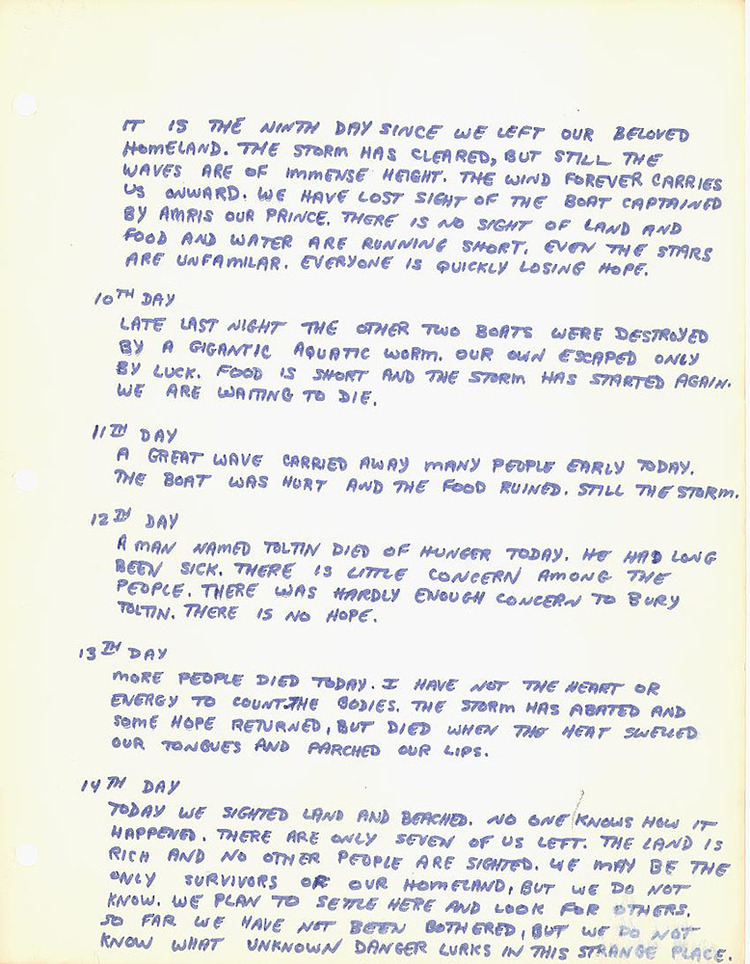
Very shortly after this, Snodal’s Saga emerged.
Greg often claimed not to have read any fantasy fiction prior to starting his studies at Beloit College in Fall ’66.
“In college I met Elric, then Bilbo and Frodo, then Conan, in that order. Those were the years when Lin Carter was editing the Adult Fantasy Series for Ballantine. I was lucky enough to get exposed to the old masters like Dunsany, Lovecraft, Smith, and then the rest of Moorcock’s tales”. 4
The world of Glorantha (initially called Acos, or Glorinthael, or Glorinthaela) was discovered mostly by recording its history, through slightly medievalist fantasy tales, genealogies, and other fragments: endless pages of text, with occasional maps.
Much of this material is still present in later versions of the setting, but often hidden, or buried, or fossilized, or evolved. It forms a deep-lying stratum that underlies everything laid down later. It was later described by Greg (in his introductions to the Roots of Glorantha books) as “the deep skeletal origins of the world”.
Equally, a great deal of this early writing remains essentially invisible in the later setting. The first encounters with Argat and Gbaji, circa 1970 while recovering from serious ill health, would prove the most impactful in the longer term.
The early material is still thrust to the surface in some places, most notably for me in 2014’s The Guide to Glorantha. This early writing was the work of a single creator but it was still a world in flux. Details of history, names of gods, everything was vulnerable to change.
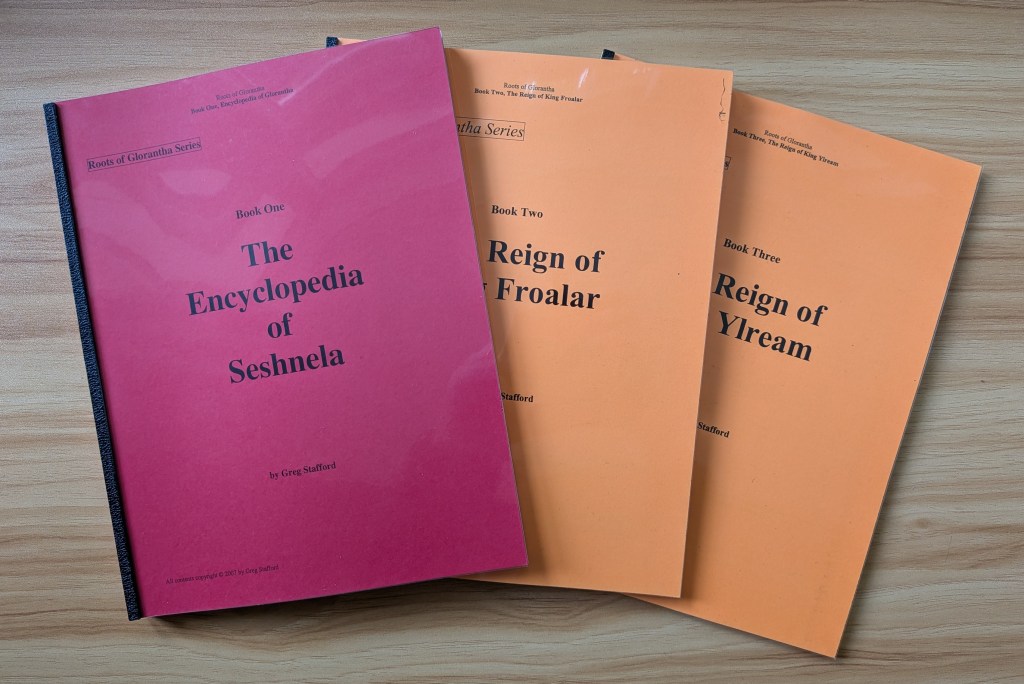
The introductions to the Roots of Glorantha books cite the years “1966 to 1976, or so”. Most of the early Gloranthan material was written by Greg, seemingly mostly for his own interest, although occasionally for an audience of one other.
“I kept working on it for years all on my own. I would read portions to my girlfriends, because it was a cheap date. Generally, though, it was not well known, not well shared”. 5
Later in life, Greg recalled a very early vision of a more expansive future for Glorantha.
“One day I was standing next to Blaisdell Hall in Beloit College and the whole world opened up for me. It was like I had a tiny little peek hole in the stories I wrote, and suddenly it was, vast, infinite. At that time I remember thinking very clearly, wow, this thing is so big that it’d be so cool if someday there was a whole staff of people to work on this thing … you know, dozens of people that were familiar with it and would be able to contribute to it”. 6
Dragon Pass, Prax, and new explorers
1975 to 1977.
Dragon Pass (White Bear & Red Moon, 1975) and Prax (Nomad Gods, 1977) were discovered.
“The first version [of WB&RM] wasn’t set in Glorantha, but in a new fantasy world of empire versus barbarians. But it didn’t take too long for this to conjoin with Glorantha. I abruptly realized one day that my in-design game map would fit right into a notorious blank space in my setting, and thus was born Dragon Pass, the Orlanthi and the Lunar Empire.” 7
By the time of Nomad Gods in 1977, the connection of these games to Glorantha was clearer.
In the early 1970s, Greg had tried selling his fantasy fiction, presumably his Gloranthan material, to magazines. For the most part he met with rejection. Following one especially notable rejection 8, he decided to pursue a different outlet.
Greg later said that he had been struck by the idea of “using the systems of sword-and-sorcery hackwork and mythical archetypes to create a do-it-yourself novel” 9, i.e. interactive fiction in the form of a game, White Bear & Red Moon.
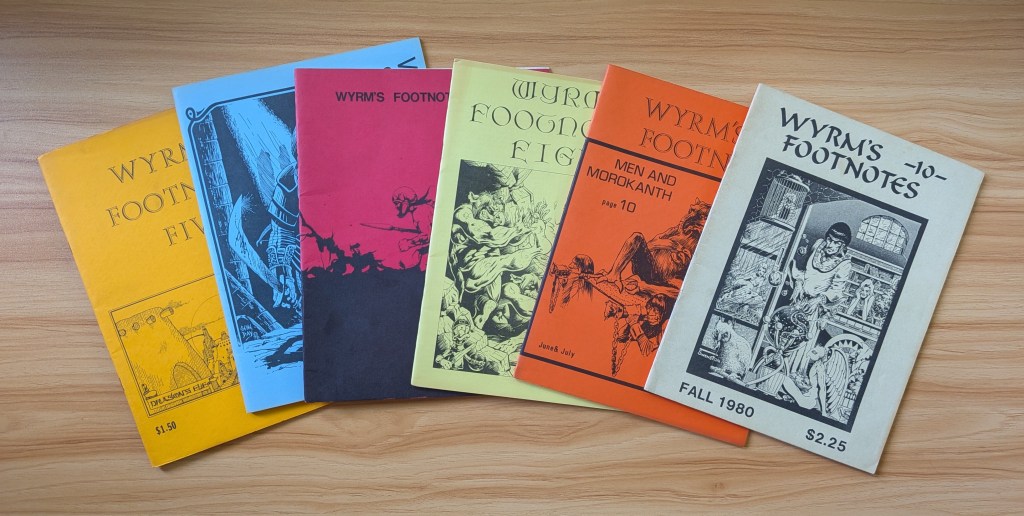
The seeds of much of later “core Glorantha” were found in these two boardgames and in the magazine Wyrm’s Footnotes (1976-1982). There were gods, but often not as they would be known later: e.g. the “Six Dawngivers”, and the “Soul Arranger” (later a.k.a. Larnste).
For the first time, others were able to enter Glorantha for themselves and explore the epic sagas of the Hero Wars, but only in a limited way, constrained by the limitations of chits and dice. The events and outcomes might change each time the game was played, but the pieces and the maps did not.
The territory was tightly defined and the maps weren’t yet intended for others to extend or annotate. But assembling and releasing games was not a solo effort, and several of Greg’s friends had helped to playtest and assemble both games.
The first marks clearly made by others in Glorantha were mostly names of places, all named after Greg’s close associates: Swenstown, Jonstown, Biggle Stone, Alda Chur, Pairing Stones, Wilms Church, Pimper’s Block, Cam’s Well, Hender’s Ruins, Tourney Altar, Tada’s High Tumulus 10.
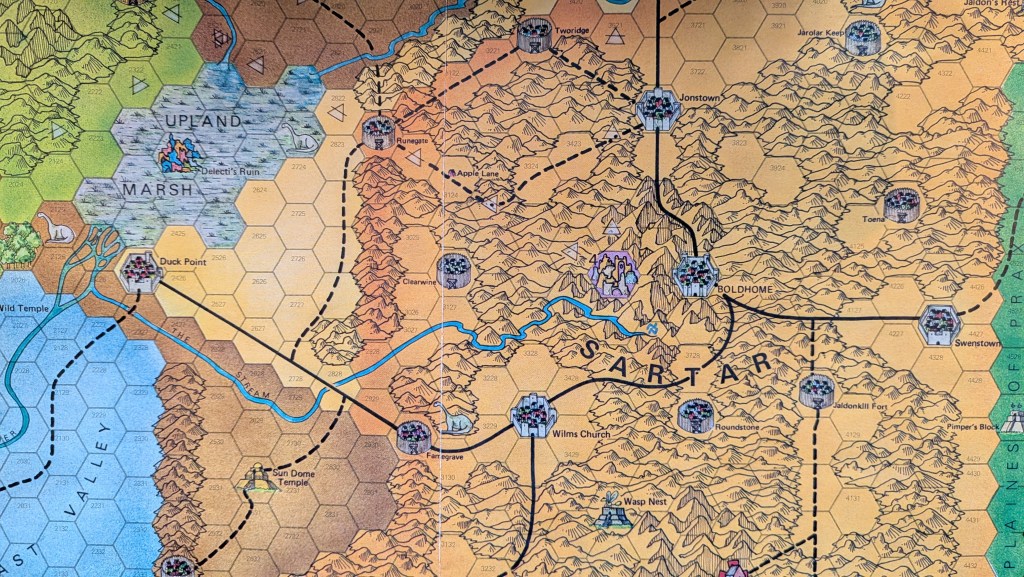
Of the contributions by others, I wonder whether William Church’s art for the chits and maps had the most lasting influence on the setting. Although credit is also due to Brian Crist, whose suggestion of a city called Duckburg (swiftly amended to Duck Point), would be responsible for the introduction of one of Glorantha’s defining non-human races.
The first great exploration
1978 to 1983.
A portal was created, in the form of the role-playing game RuneQuest, whereby visitors could not only enter Glorantha, but could explore parts of it which were previously unknown even to its creator, making their own discoveries. Most of their discoveries went unpublished, but some of their findings would soon be made “official”.
From 1978 onwards (from Wyrm’s Footnotes #4), it was explicit that the territory of Dragon Pass and Prax were part of the wider Glorantha, as Greg began to report in greater detail on the world’s geography and myth.
The God Learners were revealed in Wyrm’s Footnotes #5, appropriately enough, as a freshly organized understanding of Gloranthan myth and history was now steadily pursued and revealed. Most of it bore only a glancing connection to the Roots of Glorantha phase.
Examples of parts of the world which were explored and defined by others at this time include Pavis (Steve Perrin), Snakepipe Hollow (Rudy Kraft), Balazar and the Elder Wilds (Rudy Kraft and Jennell Jaquays), etc. This was virtue made out of necessity: if you allowed others freedom to explore your sandbox, they would of course find things you didn’t know were there. And if you wanted to make money from the setting as the owner of a games company, relying on a sole creator as a long-term bottleneck isn’t a great plan.
Greg’s late-60s vision of “a whole staff of people to work on this thing” was coming true. The result was that the creator often became editor, as with books that were essentially compilations of input from others: Cults of Terror, or Borderlands.
For me, the best of this material had a narrower voice and strong input from Greg himself: Cults of Prax (with Steve Perrin), and Trollpak (with Sandy Petersen). However there was sufficient editorial control that all of these publications remain recognizable as the world of WB&RM and Nomad Gods. Key parts of the setting were now crystallising rapidly:
“I wrote volumes of history, maybe a million words, and every so often there would be something new for me about [the trolls]. In one very old tale, about the Fronelan Jonat, two things appear which are like trolls, but are quite different. Now only one of those is a troll, the other is a different monster”. 11
The Roots of Glorantha material (largely set in the West of Glorantha’s northern continent) was largely pushed to one side by the focus on Dragon Pass and Prax, but the connections to it were still visible. Ralios, Seshnela, Altinela, Gbaji and more all appeared in the RuneQuest 1st or 2nd edition world maps and text. The Serpent Kings, the Hykimi and Gbaji, mentioned briefly in Cults of Prax, also connect back directly to the Roots. The history and cosmology in Cults of Terror cross-referenced Brithos, Hrestol, the Sunstop, Arkat, the krjalki, and other forebears from the Roots material.
Circa 1980, there were even plans to publish a Brithini / Western supplement for RuneQuest, written by Charlie Krank, and repeated promises to share Fronelan material in Wyrm’s Footnotes – all of which came to nothing.
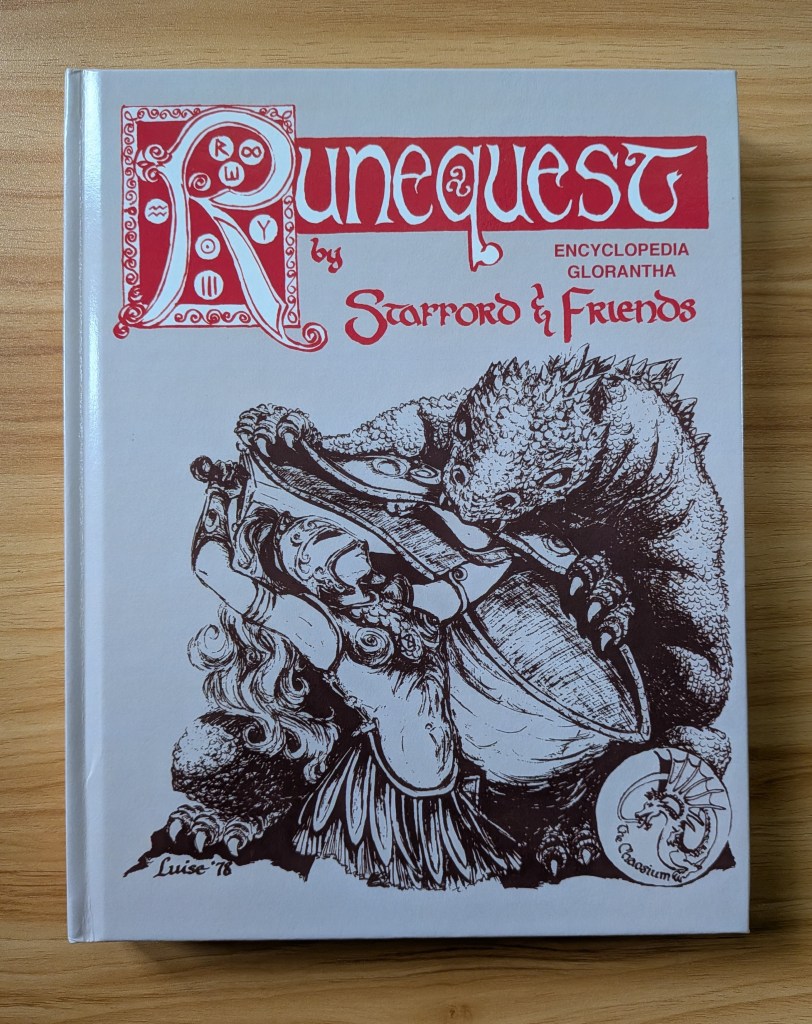
Although other voices were now very much present, Greg was clearly hard at work weaving his world closely together throughout this time. Around 1980, he was assembling a reference work for others, The Hero Wars: A Gloranthan Encyclopedia, the beginning of an encyclopaedic urge that soon fed into other books.
The first age of canon
1984 to 1990.
The God Learners had been first described in print way back in 1978, in Wyrms Footnotes #5. It was recorded that the God Learners had “evolved the Mythical Synthesis Movement”, an attempt to reconstruct “the mythical realities of the Gods Age”. Perhaps this was an echo of the coherent version of Glorantha that Greg had been steadily building, working hard to integrate the work of colleagues like Kraft, Jaquays and Perrin into his world vision.
Maybe something of that impulse lay behind Gods of Glorantha (1985), Glorantha: Genertela, Crucible of the Hero Wars (1988) and Elder Secrets of Glorantha (1990). Amongst other things, there was enough broad detail here to bring together still more of the Roots of Glorantha material with the fruits of the Dragon Pass / Prax period.
Further material, covering Pamaltela, the Islands and Oceans, was prepared but left unpublished (until it was released as the part-finished Missing Lands in 1998).
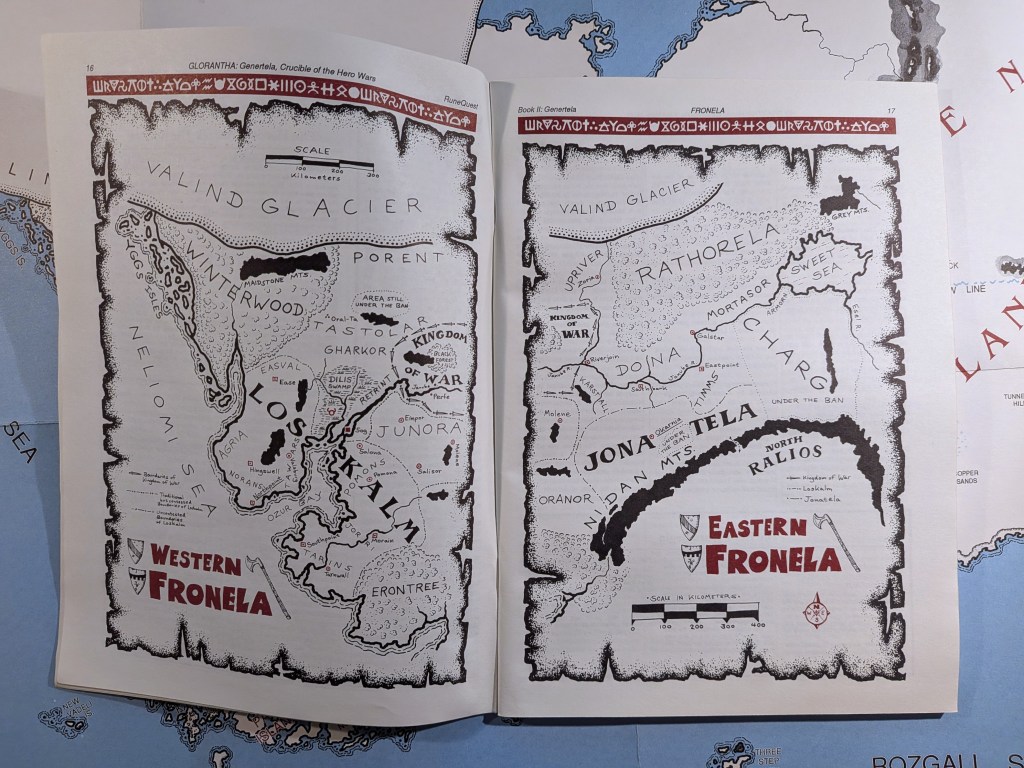
Much of the content of the Genertela book drew upon the early Roots material, but heavily evolved (most of Roots depicted the setting’s First Age, rather than the Third Age, and there was also the benefit of hindsight). Loskalm, Seshnela, the Brithini, Kralorela, Teshnos, the Luatha, Ralios, the Basmoli / Pendali lion-men: there are plenty of throwbacks, all well-integrated.
Documenting the world remained a collaborative effort: for the three box sets, Sandy Petersen was listed as the main co-author working alongside Greg, with input also from William Dunn, Charlie Krank, and Steve Perrin.
The box sets were encyclopedic in scope. Although much of the setting had been well-defined while the 1st and 2nd editions of RuneQuest were being published, the 3rd edition offered the chance to consolidate and expand. Greg even suggested that this might soon exhaust the encyclopedic imperative:
“What is the future for Glorantha? We have reached the end of the Third Age. Its inhabitants and regions will soon all be detailed”. 12
I believe the big picture of the world has remained broadly true since then, despite some changes in detail. Much of the structure and text in The Guide to Glorantha is taken directly from Genertela: Crucible of the Hero Wars, for example.
During this first part of the RuneQuest 3rd edition period, intentionally or otherwise, there were no new adventures published to expand the understanding of “local” Glorantha. Of course, visitors to the world continued to discover it for themselves.
In hindsight, this feels to me like a period of consolidation, and what might be considered Glorantha’s “first age of canon”.
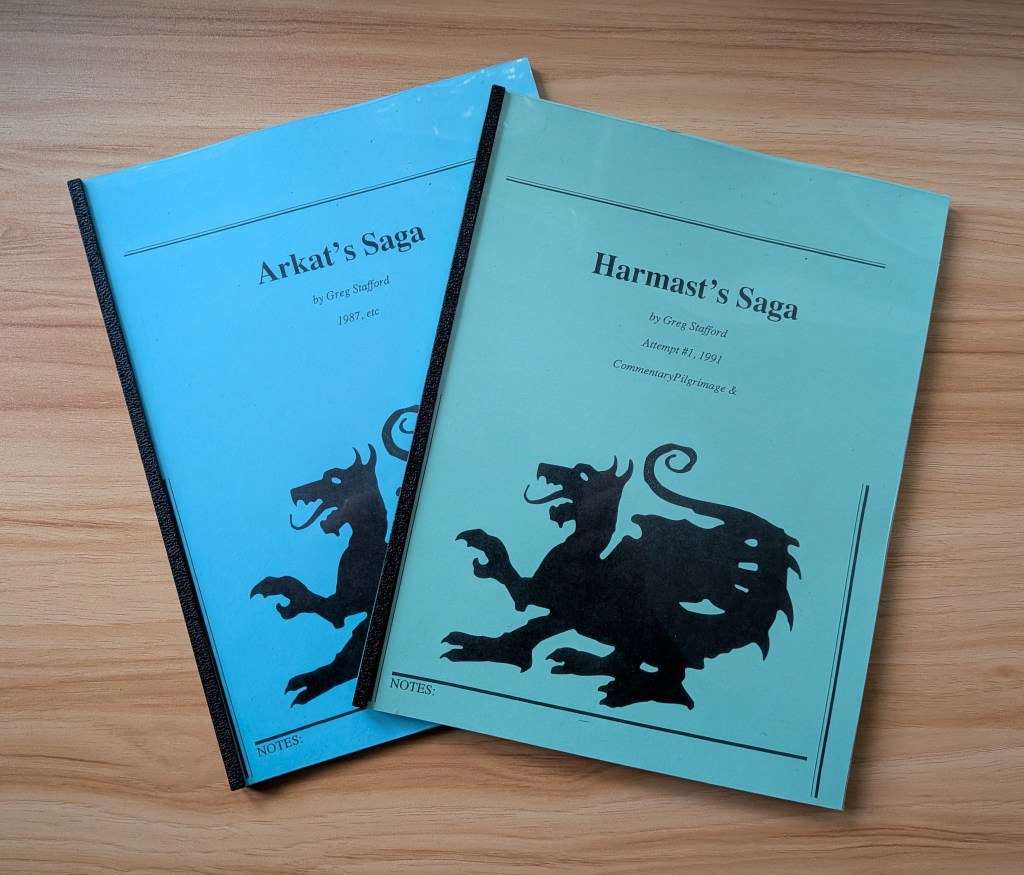
Towards the end of this period, away from the gaze of the most of his audience, Greg was working on a very different approach to Glorantha, returning to the fiction-first approach of the Roots period. Early text for Arkat’s Saga is dated 1987-1990, with writing for Harmast’s Saga following shortly afterwards.
Exploration through archaeology
1992 to 1995.
This period is popularly known as the RuneQuest Renaissance. It was open mostly to others to expand upon Glorantha in print, and with the exception of Dorastor, the results were very localized, starting with Sun County (1992) and generally not venturing very far from that general area. Many of the authors were left to do their own thing:
“[Sun County?] I have seen it, but haven’t studied it. It looks quite good; all my hard-core Glorantha mates think its great”. 13
Fan publishing also began to make an initial impact: Tales of the Reaching Moon (1989-2002); RQ Adventures (1993-1998); Codex (1994-1995); New Lolon Gospel (1995-1996). For the most part, the fan authors saw Glorantha as a territory ready for further exploration: consistency maintained where possible, but with freedom to set out along many different creative pathways.
During this period Greg embarked on a new set of journeys into the world’s hidden depths and mysteries, conducting a series of speculative archaeological investigations to better understand parts of the world that had not previously been properly explored.
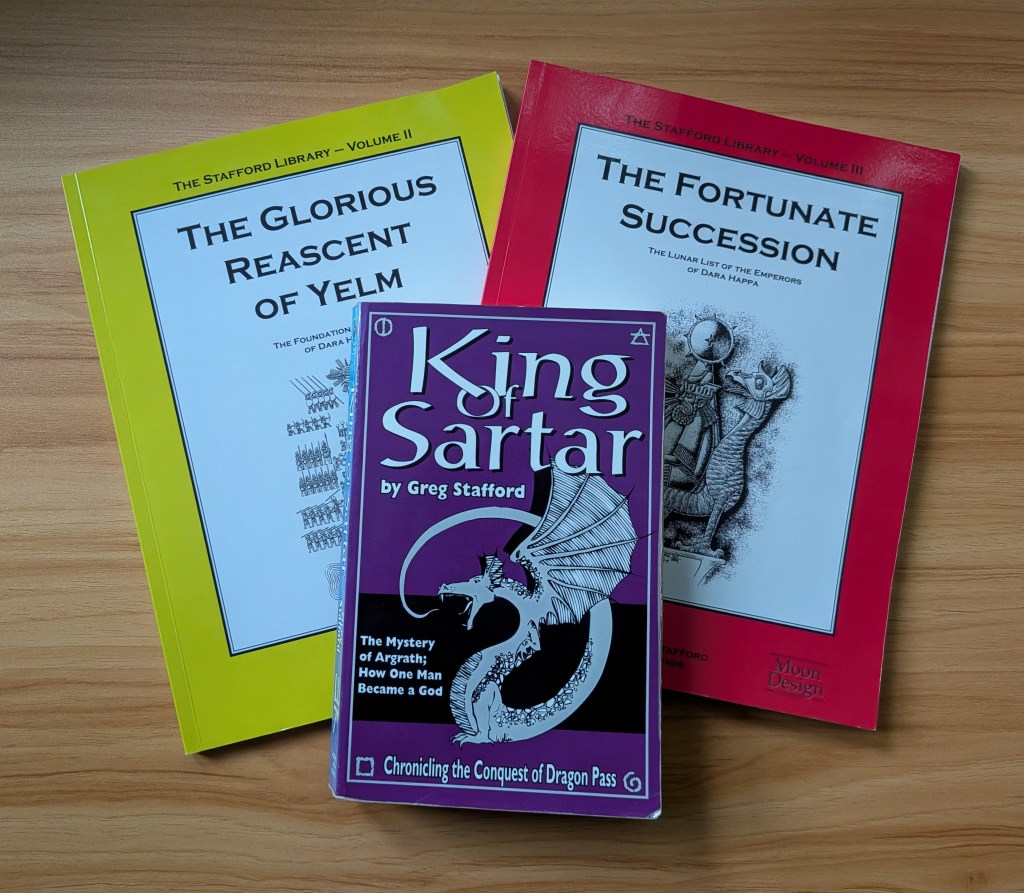
This began with King of Sartar (1992), which explored the future but also shared far more information for Dragon Pass than had been published since 1975, and then Glorious ReAscent of Yelm (1994) and The Dara Happan Book of Emperors (1994, renamed The Fortunate Succession in 1995). These works sought to unearth (or explore more deeply) historical and mythic perspectives well beyond those from the previous phase.
Each of these had a specific quarry in mind: King of Sartar to better elucidate the past, present and possible future of the Sartarite Orlanthi; and Glorious ReAscent and others to reveal archaeological strata that underly the Lunar Empire. The latter were created as part of a never-completed project to publish an in-depth Lunar Book.
There were collaborators, with some of these books credited to “& friends”, but for the most part this feels like a return to the initial period of the solo historian. Jeff Richard has suggested that as the commercial failure of Chaosium’s deal with Avalon Hill became increasingly clear, Greg’s interest in wider publication of his own material diminished. This allowed a return to a more experimental investigation of the world. 14
If Roots of Glorantha had remained largely buried deep underground (the texts would first be circulated in any significant way only in 2007), Greg’s new “unfinished works” found a small but dedicated audience of enthusiastic fans (and a handful of collaborators). Prepared largely as “deep background”, in-world texts retrieved from a mythic prehistory, they would sometimes later be read as holy writ in a way that I think was never really intended.
Resplendent in divergence?
1997 to 2007.
The short-lived RuneQuest Renaissance was over. In 1997, Greg Stafford founded a new company, Issaries Inc., to hold the rights to Glorantha and publish an entirely new game.
Glorantha began to diverge. David Dunham’s King of Dragon Pass computer game (1999) explored its own view of the setting, and fan publications flowered: Tradetalk (1996-2009); Enclosure (1997-1998); Ye Booke of Tentacles (1998-2006); The Unspoken Word (2001-2004). Many different visions of the world, some again in collaboration with Greg, but mostly their own thing. This productive flowering largely ceased when Issaries Inc issued its infamous Fan Policy in 2005.
For “core” Glorantha, this period may seem like another period of consolidation, but with hindsight I think it is something different. My impression is that Greg seems to have been content to sit much more in the background.
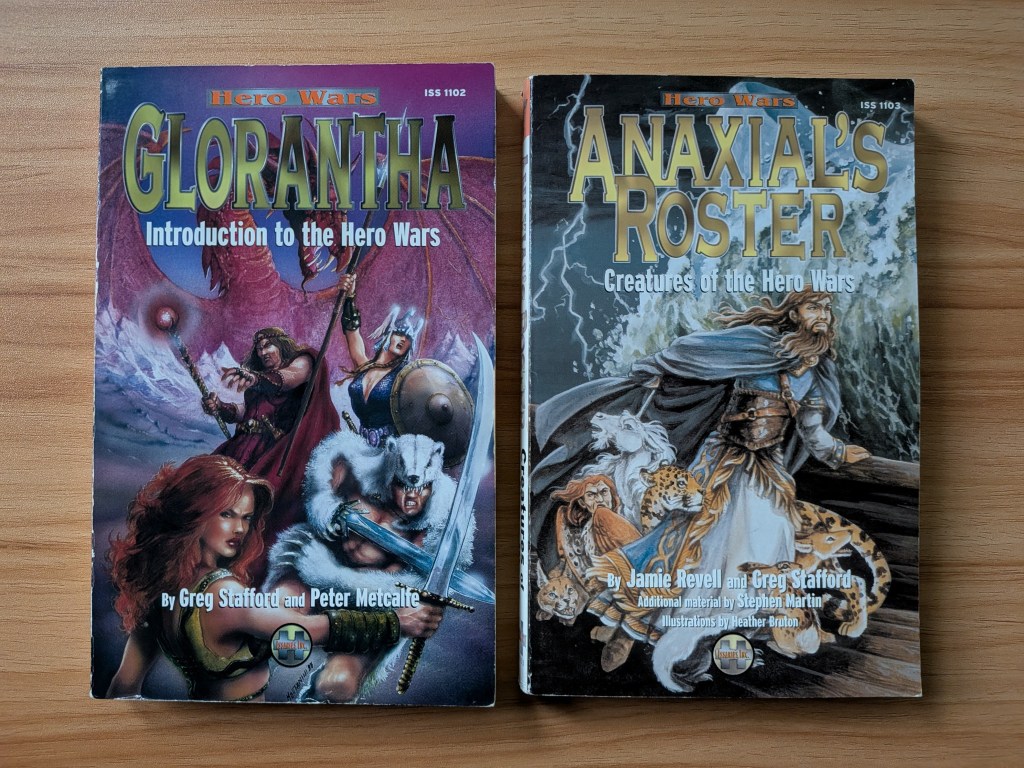
The world was defined and redefined by others with Greg’s benevolent oversight: Peter Metcalfe’s Glorantha: Introduction to the Hero Wars (2000); Jamie Revell’s Anaxial’s Roster (2000); and then numerous others contributing to Thunder Rebels, Storm Tribe, the Imperial Lunar Handbooks, Blood Over Gold etc. It seems as though the Great Compromise was being rewritten, with the perspective of Glorantha from King of Sartar and The Stafford Library seen here somewhat refracted.
“I don’t have the time or inclination to scrutinize everything, and it’s been an interesting piece of introspection to see what I really care about. And the answer to that is that I really care about the facts of Glorantha, but the interpretation of those into the various game formats is of less interest.
“So when it comes to already-established Gloranthan history, or a list of cities of Slontos, then I care a lot. If it’s a method to portray magic, I care less. And finally, I am also willing to accede to authors’ suggestions and desires and change things if the reasons are good enough”. 15
With less editorial restraint, we got “based on the works and ideas of Greg Stafford”. And many of these visions would later be rowed back, when the next phase of consolidation returned.
A wild Mongoose chase
2006 to 2010.
I’ve read very little from this period, but I get the impression that the trend set in the previous phase extended further. Other scholars here began to explore Glorantha’s Second Age in detail, very much in the “based on” mode.
“We agreed to have Mongoose do the Second Age in large part because I have done very little on that era, and thus they can have a lot more creativity with much of the material. (Learning to let go a little bit and allow the authors more leeway to express their own creativity—within the “laws” of Glorantha of course—has been one of my long lessons to learn in this biz.)” 16
The consolidation era
2009 to 2017.
The “RuneQuest Effect” 17 has been described as being when the intrusion of an ever-growing number of subjective voices into Glorantha causes the integrity of the world itself to splinter. In Gloranthan history, these end-of-Age periods lead to catastrophe, followed by the consolidation that marks the beginning of a new Age.
The previous two periods (Issaries and Mongoose) had led to an increasingly splintered Glorantha. In this new period, Jeff Richard began to restore order to the world, beginning yet again with the lands of Dragon Pass and Prax first explored over three decades previously: Sartar: Kingdom of Heroes (2009), Sartar Companion (2010), Pavis: Gateway to Adventure (2012). These were followed by two further campaign books set in Sartar in 2016-2017. No wonder Dragon Pass is the central site of mythic conflict in Glorantha: even the scholars constantly battle to redefine what’s there.
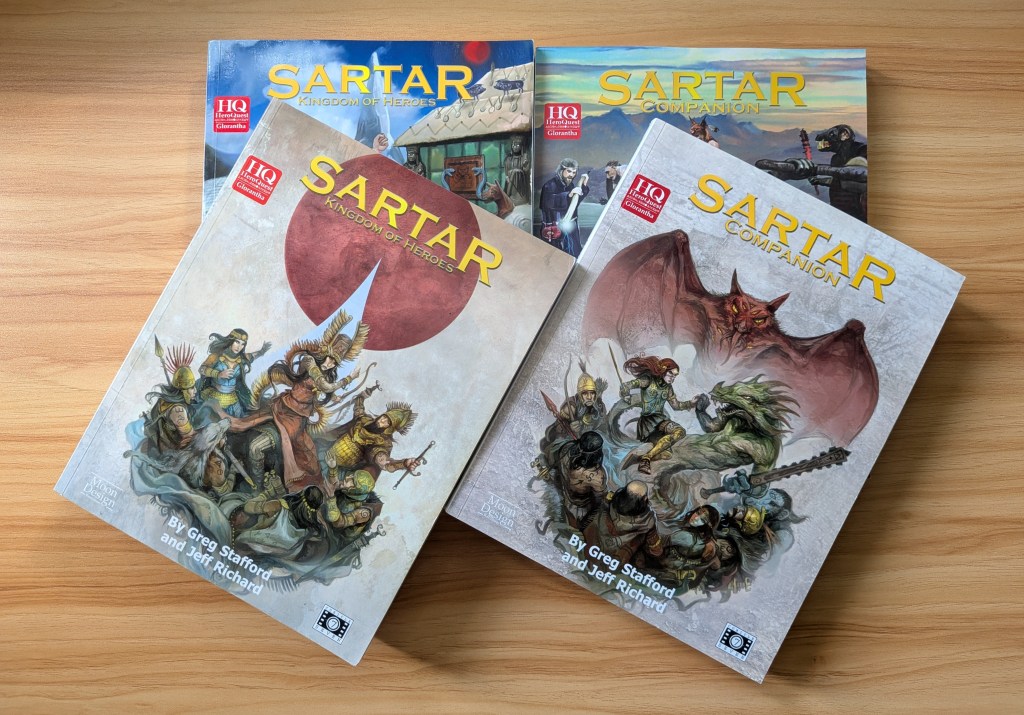
There seems to be a clear effort here to go from “based on” back towards “adhering to”, but there are still plenty of trappings of the 2000 to 2007 period that hadn’t yet been deprecated.
The second age of canon
2014 to date.
This most recent age began with Glorantha’s first official encyclopaedia: The Guide to Glorantha. A monolithic compendium of holy writ 18 that opened the way to a series of further definitive texts, the RuneQuest: Roleplaying in Glorantha line.
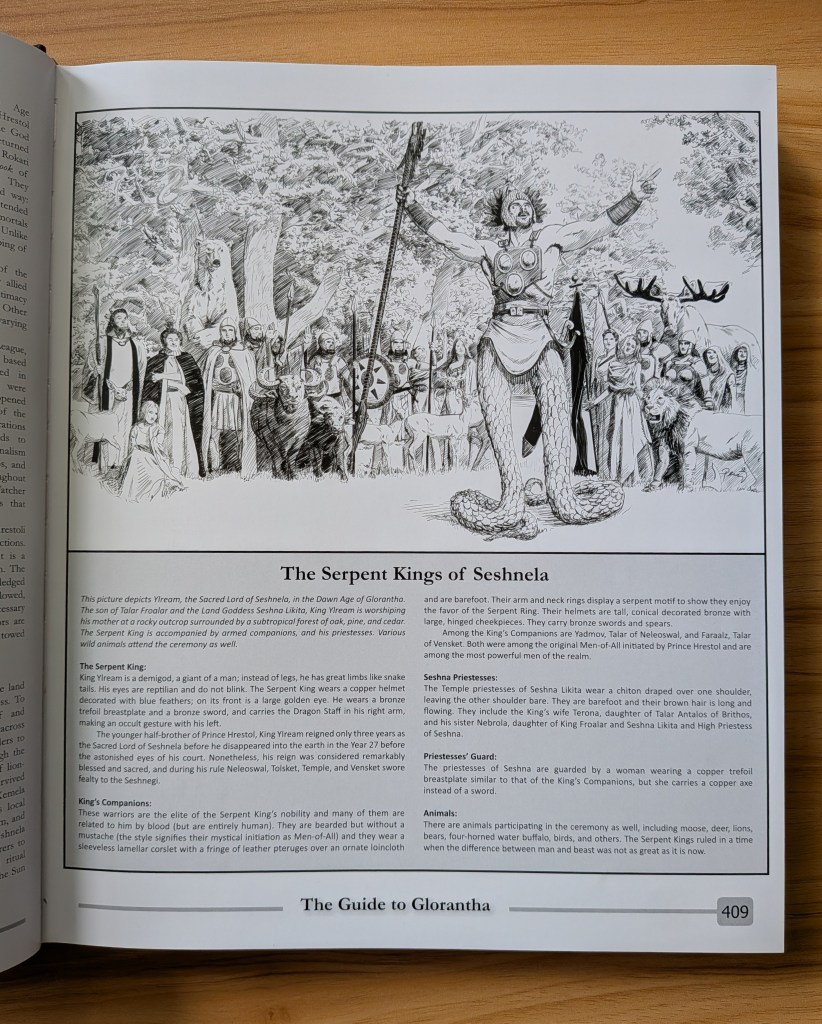
The Guide draws upon pretty much every era of previous Gloranthan writing and publication, but its heart is the first age of canon, the Avalon Hill big boxed sets.
“As far as my vision and outlook goes in presenting the vast world that I saw back in 1966, I could never really do it. I really had been trying to publish this book for 45 years and never succeeded until I got out of the way and let some other people let their own powers loose in this world. The result is this book, which I am just totally chuffed about”. 19
I think no previous period of (official) Gloranthan publication has depicted the world with such consistency (and in many cases, this level of definition). Other voices contribute, but the level of editorial control is very tight. There is no equivalent (yet) of a modern Griffin Mountain or a Sun County i.e. major campaigns and sourcebooks written by other authors but released by Chaosium itself.
The Golden Age
2019 to date.
The Jonstown Compendium community content program allows other explorers of Glorantha to record and share their own discoveries with official consent and support. There is a river of fan material that presumably began in 1978 (game write-ups in APAs etc), although its own history is perhaps best recorded from 1986 (Rune Riter and Pavic Tales) onwards 20.
Over time, the flow has risen and fallen, sometimes even ceasing entirely for a short time. On numerous occasions sediments have washed across from Glorantha-alternative into Glorantha-prime.
At its peak, the Gloranthan fan publications of the 1990s and early 2000s ran to around 500 pages of content in a year. In one quarter of 2023 alone, the Jonstown Compendium published over 1500 pages of material 21, and I suspect the rate must have increased since then.
Since 2019 this fan material has become a torrent, to the extent that the volume of Glorantha-alt knowledge dwarfs the volume of material being presented in the current phase of canon. The “monomyth” version of Glorantha proceeds on its way slowly and deliberately, but the “opening up” period that in the past has followed on from such a phase is instead now happening simultaneously.
Notes
“Opening up” and “closing down” are both creative acts, and never as readily separable as suggested in this short history. They are both fundamental to the creative method: invention, and decision-making. Design requires both imagination and synthesis.
Everything in Glorantha emerges from the font of Chaos before being placed into order as part of a Great Compromise. Sometimes a struggle must take place first, to resolve conflicting possibilities.
This history necessarily simplifies those phases of creativity, and concentrates on an axis of solo vs collaborative creation. There are other measures that could be explored:
- simplicity (monomyth) vs multiplicity and ambiguity of in-world “truth”.
- the general tendency towards “canon”, and away from what was once called GAG (“generally accepted Glorantha”), or from the increasing incoherence of some periods (I’m suggesting that these trends emerge directly in response to previous phases where looser, collaborative creativity led to an incoherent IP).
- creation through the generation of an archaeological record (Roots, Stafford Library) vs through direct exploration of the ruins (adventures and game playing).
- breadth and depth of definition (a world to explore) vs the conscious provision of blank lands (a world to co-create).
- the fossilisation of the past vs the ongoing desire to revise and refresh.
There is much more to be written regarding the history of unofficial Gloranthan creativity. This has perhaps paradoxically reached its current peak right alongside the strongest ever official commitment to understanding and presenting the setting in a coherent, accessible and comprehensive manner.
I’m wondering whether there’s a new and more sustainable model here that’s very different to the ebb-and-flow, the breathing in and out, of previous development.
I also think there is substantially more scope for alt-Gloranthas to emerge than the creative community seems willing to consider. Perhaps the community content model embraced in this new Golden Age encourages creators to direct their attention towards the marketplace rather than to pursue flights of fancy that stray further afield.
(Short history my arse.)
- Mythology in Roleplaying seminar, with Jeff Richard, Gen Con 2014. All quotations are of Greg Stafford unless otherwise noted. ↩︎
- Interview with Ian Livingstone in White Dwarf #17, 1980. ↩︎
- Designer’s Notes from The Pendragon Campaign, 1985. ↩︎
- Interview with Ian Livingstone in White Dwarf #17, 1980. ↩︎
- Interview for The Guide to Glorantha, YouTube, 2012. ↩︎
- Interview for The Guide to Glorantha, YouTube, 2012. ↩︎
- A Brief History of Chaosium, Inc, The Stafford Codex website, undated. Note that elsewhere, Greg said that “I have been writing an epos of generally unpublishable sorts for going onto ten years now. These writings form the general background for White Bear and Red Moon, strengthened by certain
realizations I have had over the years concerning the reality of mythology” – Wyrm’s Footnotes #1, 1976. ↩︎ - “All sword and sorcery is cliches”, Greg quoted Jessica Salmonson of [The Literary Magazine of] Fantasy and Terror as responding to his submission – see Wyrm’s Footnotes #1. ↩︎
- Interview with Ian Livingstone in White Dwarf #17, 1980. ↩︎
- For more details, see https://wellofdaliath.chaosium.com/maps-legends/. ↩︎
- Designer’s Notes from Trollpak, 1982. ↩︎
- Designer’s Notes from Glorantha: Genertela, Crucible of the Hero Wars, 1988. ↩︎
- Interview with Nick Leaning, Australian Realms #8, 1992. ↩︎
- BRP Central, 2024. ↩︎
- Interview with Shannon Appelcline, rpg.net, 2006. ↩︎
- Q&A with The Acaeum, 2007. ↩︎
- BRP Central, 2024. ↩︎
- This is not intended pejoratively. ↩︎
- Interview for The Guide to Glorantha, YouTube, 2012. ↩︎
- Shannon Appelcline’s Gloranthan Fandom & Fanzines: 1985-2018 and Glorantha Periodical Timeline give a handy overview. ↩︎
- BRP Central, 2024. ↩︎


Leave a Reply